Pages

Kamis, 29 Januari 2009

Does This Stimulate Change?

The Washington Post is onto something here ("An Education Stimulus?")
EDUCATION is poised to win big under the economic stimulus plan hurtling through Congress. But it remains to be seen whether America's schoolchildren really will be helped by the huge investment of public funds that is being planned. After all, it seems that much of the billions of dollars of new federal spending is aimed at continuing programs and policies that largely have failed to improve student achievement. For the amount of money being spent, Congress should insist on real change, not simply more of the same.
Its editorial underscores what I was saying yesterday in this post ("Overstated"). More money by itself won't produce educational reform unless the way that money is spent locally changes. It doesn't appear that such requirements will be made part of the stimulus legislation. Thus, the federal role in education isn't poised to become more significant apart from covering a higher (albeit still small) portion of overall education costs.

The Iceman Cometh


Amen! "Washington Post: "As To Ice, Chicago Still Obama's Kind Of Town".
"My children's school was canceled today," Obama said, speaking to reporters before a meeting with business leaders. "Because of what? Some ice? . . . We're going to have to apply some flinty Chicago toughness to this town."
In 2001, the first of three winters I lived in Washington, DC, I innocently walked into my local grocery store one evening on my return home from work. Before me stood dozens of Washingtonians scooping up batteries, bottled water and toilet paper, with checkout lines stretching halfway up the aisles. Why? Two-to-three inches of snow was forecast for the next day. A native New Englander, I rolled my eyes and walked out.

If we lived like that here in Wisconsin -- or in my former Vermont -- the entire state would shut down for half the year. Not gonna happen.

I think President Obama is onto something. Maybe as a condition to giving Washington DC statehood, the Prez should insist on more "Chicago toughness."

In Chicago, where the President's daughters previously attended school, the schools haven't closed for weather since a 1999 ice storm.

------------------------------------------

UPDATE: Just discovered that Huffington Post, Alexander Russo and Kevin Carey beat me to the punch on this one. Guess it takes longer for news to reach Wisconsin ... especially through all this ice and snow.

Rabu, 28 Januari 2009

Overstated

I'm sorry. Am I missing something?

How is the infusion of new federal resources for schools in the stimulus bill going to transform the federal government's role in education? I just don't see it.

Today's front-page New York Times article ("Stimulus Plan Would Provide Flood Of Aid to Education") couches the stimulus bill as a transformative vehicle.
The economic stimulus plan that Congress has scheduled for a vote on Wednesday would shower the nation’s school districts, child care centers and university campuses with $150 billion in new federal spending, a vast two-year investment that would more than double the Department of Education’s current budget.

Critics and supporters alike said that by its sheer scope, the measure could profoundly change the federal government’s role in education, which has traditionally been the responsibility of state and local government.
Hey, $150 billion is nothing to sneeze at. But it still represents a fraction of overall education spending. According to the U.S. Department of Education, federal dollars currently account for less than 9 percent of overall education spending. State and local dollars account for more than 80 percent of the total. Even with a doubling of federal outlays, Uncle Sam would still account for less than 1 in 5 dollars spent on schools.

Republican leaders are crying wolf as well. From the New York Times:
Howard P. McKeon, Republican of California and the ranking minority member of the House education committee, said, “By putting the federal government in the business of building schools, Democrats may be irrevocably changing the federal government’s role in education in this country.”
Listen, short of the inclusion of some major new education policy in this stimulus bill (which won't happen) - greater accountability for spending, such as Title I and Title II dollars, for example - how is this piece of legislation going to "profoundly change" the federal role in education? Answer: Apart from coughing up some new federal resources at a time of need, it's not. It won't fundamentally change the business of teaching and learning without further legislative and policy changes. We still await action on ESEA reauthorization - the next best hope for positive changes and needed reforms to current federal law.

Saying something represents change doesn't make it so.

You Really Like Us...

The Education Optimists just received its 10,000th visitor today. When we began this blog in the middle of last year, we had no idea if people would actually read it. How gratifying that people actually are.

But please stop ringing the doorbell ... just come on in!

Sabtu, 24 Januari 2009

Tuskegee and the Obama Effect

By now you've all heard the fascinating news of a study (New York Times: "Study Sees An Obama Effect As Lifting Black Test-Takers") that seems to demonstrate an Obama effect on the black/white gap in test scores. In short, a team led by a Vanderbilt University researcher administered a series of 20 questions (drawn from verbal section of the GRE) shortly before Obama's nomination and again after his acceptance and then again after the election. Black performance on the test improved after Obama's acceptance, and rendered the black/white gap in test performance nonsignificant.

I'm the first to admit the potential for an Obama effect. Every time I hear him speak I think of the power of a role model, and dream of possible studies that could uncover such an effect.

But in this case, I'm not so sure what's being captured is an effect of Obama on the confidence of black students in their academic performance. Here's why:

(1) The students taking the test at each administration were different students. If the same kids took the test repeatedly, obviously we'd expect their scores to increase.

(2) According to the lead researcher, in a personal communique with me, while the pool of potential participants was constructed at time 1, the actual sample at each time was based on volunteers offered a monetary incentive to participate (what size incentive? I don't know).

There are more critical pieces of information missing as well:

(a) Whether the reasons for participation vs. non-participation differed by race, and are correlated with test-taking ability.

and

(b) Whether the rates of participation were similar for both racial groups.

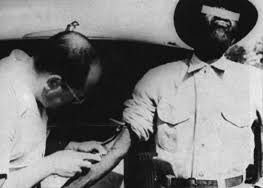
What we do know is that ever since the Tuskegee Study of Untreated Syphilis (TSUS), African Americans are less likely than Whites to volunteer for participation in research. Given the known gaps in achievement, if they knew anything about what the study required they may've also simply lacked the confidence to participate. This is completely understandable. The question is, could it influence the findings in this study? Are there other plausible explanations for the change in test scores observed in the study?

Yes. Let me suggest just a few.

(1) A disproportionate effect of the economy on black's financial status. The study took place during a year of steady decline in the economic standing of many Americans. Is it possible that the money offered for participation wasn't enough to offset the concerns of higher-achieving black students about research (or to offset the opportunity costs associated with participation)? But that by time 2, the money was simply worth more (e.g. more effective as an incentive) and induced greater participation of black students? I'm positing that during the period whites were both less affected by changes in the economy and overall less averse to volunteering to take a test.

(2) An effect of Obama on black's trust in society, including researchers. So at time 1 the black students in the pool are generally more suspicious and only the lower-achievers are affected by the monetary incentive enough to overcome that suspicion and take the test. At time 2, they're feeling more goodwill towards the world, and higher-achieving black students are willing to participate.

(3) Maybe higher-achieving black students, when asked twice to do a study, tend to do it? I don't know if nonrespondents at time 1 were asked again.

These are just three ideas about how sample selection could bias these results. I have many more. What about the gender composition of the samples? ( Black men have lower test scores on average and are generally less likely to participate in studies. )

I want to quantify the good feelings we're all having in the post-Bushie world too. I get the motivation. But I don't think we should get too carried with feel-good stories on studies that have not yet undergone peer review.

Musical Elective of the Week

The Musical Elective of the Week is Liam Finn.

Finn is a 25-year-old Kiwi singer/songwriter. Not only does he have a most excellent first name, but this guy can rock! Probably best known as the eldest son of singer/songwriter extraordinaire and Crowded House founder/lead singer Neil Finn, Liam laid down the gauntlet with his first solo album, I'll Be Lightning, released in January 2008 in the U.S. He was named one of Rolling Stone magazine's 10 Artists to Watch for 2008.
Recorded with a mixing deck that once belonged to the Who, I'll Be Lightning melds Elliott Smith-style melodies with loosey-goosey execution and the big, airy harmonies of yacht rock. Finn plays every instrument on the album — and during live shows. Triggering loops he creates via pedals, he'll riff on guitar, go nuts on theremin and pummel a drum kit for a one-man-band extravaganza.
Finn is an unbelievable persona in concert, literally doing everything on stage and making enough noise to make you believe that is an entire band up there. I saw him open for Crowded House at the House of Blues in Chicago back in 2007 and was spellbound. (He later opened for Eddie Vedder in the U.S. last year.)

I'll Be Lightning is a difficult album to categorize, parts rock, folk, and experimental. Some of my favorite tracks include the first three -- "Better To Be," "Second Chance," and "Gather To The Chapel" -- as well as the Beatle-esque "Energy Spent" and "Music Moves My Feet."

Finn will be part of the very exciting, upcoming Seven Worlds Collide album featuring his dad (Neil Finn), members of Radiohead (Ed O'Brien and Phil Selway), members of Wilco (including Jeff Tweedy), KT Tunstall, Johnny Marr (of the Smiths and Modest Mouse), Sebastian Steinberg (of Soul Coughing), and others. Recording was done over the holidays in Auckland, New Zealand and several concerts were performed. Proceeds will benefit Oxfam International.

Check out more about Liam Finn at his web site.
Better to be, bigger than the other

Heart on your sleeve and hat on your head

I want to see you playing with your shadow

Hypnotise me with every step

--"Better To Be," I'll Be Lightning (2008)
Link to past Musical Electives of the Week.

Treatment of Transfers

What to do, what to do about those pesky community college students? Their graduation rates are so low, they lack big ambitions, they bring those families and kids and jobs, they're "older," they're poorer, they're loan averse... no wonder their transfer rates to 4-year schools are so low!

Sound familiar? To those of you familiar with the extended policy and academic debate about the educational opportunities created by or diverted by community colleges, well, it should.

I reported Friday about the increasing numbers of students changing colleges. And yet, and yet...here's an excerpt from a recent New York Times online chat with a couple of admissions gurus from 4-year colleges:
QUESTION: I’m curious as to how admissions criteria are altered or shifted in importance for a transfer applicant compared with a freshman applicant.

QUESTION: How are transfer applicants from community colleges viewed in the admissions process? What advice would you offer these applicants?

ANSWERS:
Mr. Poch of Pomona: There are huge variations in transfer student possibilities from institution to institution. Some have lots of room and some little or none. USC enrolls more than 1000 transfer students each year. Pomona has room for 10 to 15. Obviously different factors affect both of these patterns and common answers will be hard to find.
Transferring to Pomona is tough. There are proportionally many fewer spaces than there are for first year students in huge part because of the high graduation rate of our incoming first years. Space doesn’t open up. We look at the high school record, especially for those seeking to transfer as sophomores. We look closely at the college record and the extent to which the student has pursued a general education program which would leave them time to dedicate the time they and we would wish to their electives and their major when they enroll at Pomona. We will explore the reasons for transfer and to understand as best we may about why Pomona and how the student sees life changing in our educational environment. Are they transferring FROM something or TO something?

Mr. Brenzel of Yale: Our unusual system of residential colleges makes the freshman year and sophomore years critical to our undergraduate program. So we maintain only a very small transfer program, limited to 24 places each year.

Mr. Syverson of Lawrence: In the case of transfers, the bulk of the academic evaluation focuses on the college record. We welcome transfer applicants from community colleges and treat them essentially the same as transfer applicants from four-year colleges.

What is wrong here? Oh, let me count the ways:

1. Mr. Pomona--A nice back-handed slam against USC for admitting plenty of transfer students, by not-so-subtly suggesting that only poor retention rates could lead to another places for transfer students (Pomona's 6 year grad rate is 93%, USC's is 84%). Not true: underclassmen require different classes and services than upperclassmen. Schools often find they can fit more upperclassmen on a campus even when retention rates are quite high.

2. Mr. Pomona again-- Oh, beware that wayward transfer student who is just trying to escape from a crappy school and come running to yours... Yeah, we all know about those community college transfer students banging on the doors of 4-year schools like Pomona, just dying to run from their community college

3. Mr. Yale-- Yeah, I'm sure the 1st two years of Yale make it so different that students who did their first two years elsewhere could never merit your precious degree.

4. Mr. Lawrence-- Why treat applicants from community colleges the same as those from 4-year colleges? Why is this something you are showing off, like it's a good thing?

Bottom line- why aren't more kids transferring? Open your eyes: it's all about preserving privilege. Make the kids spend more time on our campus before they can get a degree (read: pay more money to our school). Keep out those bottom-dwelling community college goers who might try to sneak past the gates. Watch out, in all fairness, students who had an opportunity to earn a BA must be treated the same as those coming from a school that doesn't grant one!

At least there it all is, in the New York Times!