Pages

Sabtu, 05 Januari 2013

A Rocketship to Disappointment

John Merrow came out recently with a segment about Rocketship charter schools, touting high test scores among their low-income students. Merrow looks at Rocketship through the lens of a provocative metaphor: Is Rocketship doing what Ford did with the Model T, i.e, mass producing quality education?

First of all: Yuck. Though some certainly see education this way, education is not a product, or shouldn't be. It's not a car. It's not an item that can or should be mass produced. Even adorned with colorful cubicles, what a bleak and depressing way to envision to education.

Second of all: Innovative? Rocketship makes no secret that their mission is to raise reading and math standardized test scores. As I said in this post, where I referred to Rocketship education, I fail to see what's so innovative about that. Furthermore, using computer programs to differentiate instruction is hardly new or innovative. The school district where we live chose several years ago not to outfit schools heavily with technology, bucking the tech-innovation trend. Instead, the district invested in a solid technical and vocational program. There are computer labs in each school but each classroom has only about five computers. What do they use the computers for? Among other things, to differentiate instruction, or rather differentiate practice. Students can practice their math facts or other basics at their level. As long as such basics are developmentally appropriate and worth practicing, this is a fine use of computers, but the difference is the students in my district's schools only use them for small chunks of time and only for specific purposes. But such practice is hardly innovative. If anything, it's practical.

If I parked my kid in front of a screen for two hours a day, it might be called bad parenting. In a school, it looks, well, lazy. You better believe that if my kids' school did that, they'd be hearing from me. So not only is not new, it's inappropriate and possibly harmful. Yet, Rocketship does it and is praised for its "innovation" and invited to "scale up."

There is no art and music, so it seems that the majority most of the time is spent on tested subjects. When you see art and music as something that can be relegated to "afterschool," it shows that you don't respect them as the vital disciplines they are.

The report gives a big nod to parental involvement at Rocketship schools, but from what I can tell the parental involvement seems to involve watching and singing along as their children do their Launch (and an opening meeting and song is also not innovative--lots of schools and summer camps do that every day and have been for years) and agreeing that prep for standardized test scores is a priority. Otherwise, there's no exploration in the segment of how "parent involvement" translates at Rocketship Schools. How are parents meaningfully involved at Rocketship? What do they do? What "critical parts" do they play? How much decision-making power and input do they have? (And why doesn't John Merrow ask these questions?)

And don't get me started on the references to unions. Rocketship CEO John Danner starts off by claiming Rocketship is a "start up" and hence can't accommodate a unionized staff. So when it comes to unions, Rocketship is a start up but when it comes to equal public funding, Rocketship is a school. Which is it? And where is this 450-page document that Danner refers to "that literally says minute by minute what teachers are supposed to do"? (And why doesn't John Merrow ask about the existence of such a document?) The real answer: It doesn't exist; it's a boogeyman. The scripted, minute-by-minute aspect of public school days comes not from union contracts, but from management, like, say, um, someone in Danner's position who feels immense pressure to, um, yeah, raise test scores.

Lastly, while Merrow's segment states directly that the computer time may not be "working," it doesn't ask what is it meant to work towards. And it certainly doesn't ask what the heck the kids are actually doing on the computers. What are the programs? What are the games? What are their purpose? What are their efficacy? Are they good programs? (And, yes, again: Why isn't Merrow asking these basic but vital questions? Yes, yes, I get it: Learning matters. But learning what? And how?)

I'm dubious that this quixotic quest for innovation is the lever to improve education and I'm certain that the mass production door is the wrong one to be knocking on. Either way, though, if it's "quality" (another word in education reform discussions I've come to loathe) we're after, the prize ain't higher test scores. High scores are a side effect of good education, not an end. Unfortunately, higher test scores are precisely the prize Merrow exalts and Danner seeks. But nor for their children. As this article on another blended learning model in Newark, New Jersey, shows, this is increasingly the prize for low-income kids in schools like Rocketship's because that's what "those" kids need:
Even some technology advocates like Doug Levin of the State Educational Technology Directors Association doubt that this model will ever appeal to middle- and upper-income families whose children are not struggling below grade level. Levin says that’s because those children don’t need as much extra drilling and can use more of the school day for analysis and inquiry.“I think this approach works much better for elementary school aged children who are really struggling to build their vocabulary, to understand basic math facts and operations,” says Levin. “I think as kids get into middle and high school, what the computer can offer in that regard is less.”Levin predicts the computer drilling will succeed in raising the test scores of the low-income sixth graders of Merit Prep.
There you have it.


Updated (1/6/2013): 
Fellow education writer/blogger Adam Bessie recently (and not so recently) pointed out a possible conflict of interest: Rocketship is funded by the Gates Foundation and so is PBS and Merrow's production company Learning Matters (though I can't say what the nature of the arrangement between PBS and Learning Matters is). This was not disclosed during the segment, nor was it disclosed that Rocketship CEO Danner is also on the board of Dreambox, the for-profit company that produces the math software used by Rocketship. I would think it would be journalistic protocol to disclose such relationships.

But what really disturbs me is that Merrow says he had "no idea" of the connection between Gates and Rocketship. I don't understand what kind of basic investigative journalism wouldn't have uncovered that, especially when it's not hidden from the public--it's on Rocketship's website. I'm not a professional journalist, but I would think that would be protocol, as well.

Updated II (1/6/2013): 
Also, see this post on Rocketship (in Milwaukee) by Barbara Miner.


Winter Break Fun


I washed our classroom mats over vacation, Sarah is helping me roll them all!
To see the Mat Rolling Lesson, click here.  Iris was just a baby in that post :)
This skill is so important to her.  "Look, Mom, it's a tight rolled mat"  
Our Santa letter.  I'm loving the invented spelling and the thanks.
Someone had Christmas on the mind...

The Gingerbread Village (kits from Michael's- I don't have THAT much time on my hands!)
Decorated by our extended family on Christmas Day.

This is how excited they were to go back to school after vacation!! 
THAT'S A WONDERFUL THING!

Posted by Picasa

Rabu, 02 Januari 2013

iDevices controlling robots in the Classroom

iDevices used as remote controls are not new but many teachers are now looking at how some of the new robotic devices can be used as part of their normal teaching and learning.

We recently purchased both the Sphero and the iConCopter and have used both to good effect - although the iConCopter was a personal purchase. I thought it might be handy to have a look at some of the suitable options available. Obviously because of the costs these are items that may need to be planned for in the budget. They may not be appropriate as a whole class set but rather as two or three of one or more of these options that can then be used as kits for special projects or specific units of work.

The Sphero and Tankbot would be good to use with Maths, setting out the steps required to get through a maze - especially with the drawing feature in the Sphero.

Let me know if you are using any other appropriate devices that we have not mentioned here.

Sphero: $79.00 AU

Sphero by Orbotix is the world's first robotic ball and gaming device that you control with a tilt, touch, or swing on your iPhone, iPad, or iPod touch. Easily connect to Sphero via Bluetooth, then dive into unique, mixed-reality gameplay using fun and challenging built-for-Sphero apps.


You can control Sphero wirelessly from any of your iOS devices or you can use Sphero as a controller for on-screen games. The device has been engineered in such a way to encourage developers to make games for the device. The intuitive controls are easy for all ages to learn once they download the free Sphero app. Sphero can be used on wood or tile floors, sidewalks, carpet making it one of the most versatile app controlled gadgets for use in schools. I especially like the feature that allows students to draw a track that Sphero then follows.


iWheels Micro Robot: $24.00 AU


Presenting the i-Wheels Micro Robot. This is a unique design for a remote controlled device. The robot has been constructed in such a way that it can not fall over even with just two wheels. Not only does the iWheel come in four super bright colours but it is also controlled by any of your iDevices using the "i-Robot" app from App Store. It looks very easy to control, allowing you to go forward / backward, turn left / right, rotate CW / CCW. Like a lot of these robots, the learning curve may be steep for the adults in the class. Great for mazes or maneuvering over a set track.


iPhone Controlled Insects: $33.00 AU


These six legged robots are also made for HeliPal.com and happens to use the same app as the iWheels micro robot. Inspired by the movement and characteristics of an insect, the insect-like legs are manipulated by the internal structure inside and powered by a small rechargeable battery. Charge your Bug via the included USB cable and start controlling it using your iPhone, iPad or iPod. The IR transmitter allows you to control the bug up to a distance of 6 meters.


Tankbot: $33.00 AU
I really like this new toy for robot enthusiasts called TankBot. It offers infrared sensors that allow the micro-vehicle to navigate mazes, and a universal remote that plugs in to the headphone jack of an iOS or Andriod device. The TankBots also play sounds and blink when idle, and feature three modes of play.


In addition to the autonomous maze-solving mode, the toy can be set to free-roaming, acting under its own direction, as well as controller mode under the direction of an iOS or Andriod app. Each unit has a retractable USB charger built right into the body of the product, meaning no additional batteries are required. The company says that 40 minutes of charging will yield about 15 minutes of play time. The companion app allows users to control the unit using a virtual "joystick".


Romo: $195.00 AU including shipping


This is another robot I might have to purchase myself. Romo is billed as a revolutionary mobile robotic platform that uses your smartphone as its brain. When connected with any iOS device, Romo becomes a friendly robotic avatar that wanders about your home or office. Romo is the first personal robot built for everyone. He’s small but sturdy, fast, and his basic interactions evolve the more you use him.

By combining smartphones with a mobile base, they have created robots that do awesome things (telepresence, autonomous navigation, machine vision). Because software for Romo is distributed through the Apple App Store users download new behaviors and personalities for their robots at the click of a button. Anyone can build and distribute new apps for Romo using the Romotive SDK. This is being actively encouraged by the manufacturers. I also like that this was a Kickstarter project.


ParrotARDrone: $350 AU


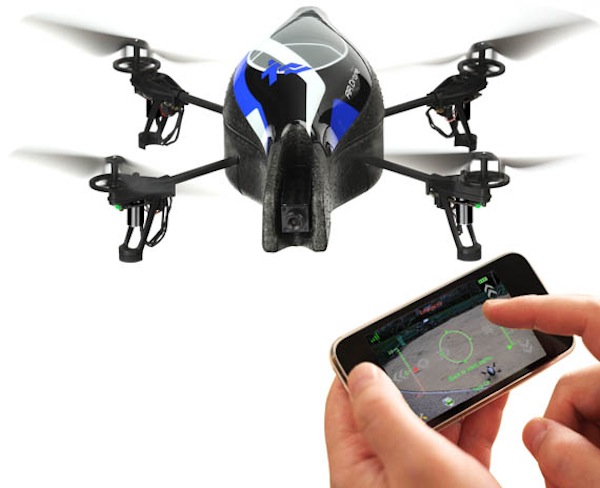
This is a bit over the top but easily fits into the notion of a iPhone control device. The AR.Drone 2.0 remote-control quadricopter combines the best of many worlds, including modeling, video gaming and augmented reality. The AR.Drone 2.0 is remote-controlled by an iPhone or iPad and features a number of sensors, including a high-definition front camera, vertical camera, an ultrasound altimeter and absolute control mode. With the AR Drone 2.0, you can now record video and take pictures while in-flight and directly share them on Youtube and Picasa. You can also use the AR.Drone in video games, such as AR.Race, a one or two-player game using an obstacle course.


At roughly $299 AU it is out of the price range of most schools, but it might be worth discussing with other faculties as a shared purchase. This would be especially good for promotional shots of the school grounds, the full student body or even football games and promotional events like fairs, Open Days and   Sports Carnivals.


Jumat, 21 Desember 2012

A Home Day & Crafts

Making garland with hand made beads

Bead Stringing

Cooking:  Mortar and Pestle, bread crumbs!

Making ornaments with applesauce and cinnamon


We rolled and rolled


The gift of crafts, doll making kit for the girls!  They are going to be so busy...


Happy Winter!!!!

Rabu, 19 Desember 2012

Sandy Hook: Celebrating Lives in the Midst of Death


As my husband and I were reading about and processing the news from Newtown, Connecticut my husband pointed me to Dawn Hochsprung’s twitter feed. “People should read that,” he said. I kind of shrugged. I am quite an active user but after reading this 2011 New York Times article I have mixed feelings about social media and what happens with it when we die. Even though twitter feeds are (mostly) public, I feel as if I am vaguely invading someone’s privacy when I look at the feeds of the living, let alone the deceased. But still, I looked.

This was the tweet that really got to me:


Just that Thursday night, my sons had performed in their 4th grade winter concert at the public elementary school that serves our community, also a small town in a rural area, also wearing white tops and black pants. The theme was "December Around the World." I was expecting it to be Christmas- and Santa-carol centric, but it wasn't at all. It was actually, well, international, and the Hannukah story wasn't the usual sanitized version.

While his siblings do, one of my sons doesn't like music class that much. He enjoys listening to music and playing instruments but he doesn't like singing, dancing and performing--he's much more of a visual artist. As he complained more and more about “play practice,” my husband and I empathized with him, but kept telling him what a great experience it was to practice a group of songs and put together a show and to perform it. We reminded him that being exposed to many subjects and experiences was part of elementary school and part of being a well-educated individual. These are the moments when my husband and I tell our children that it's important to do things they don't enjoy all that much, that they serve a greater educational purpose (versus doing test prep worksheets). As he got older, we explained he could dedicate more time to his specific interests, but that all of these broader, more various earlier exposures would help him to figure out what those interests might be. As I watched him the night of the performance, I knew he wasn’t enjoying himself, but I was so proud of him singing and dancing and doing his best all the same.

My husband, like me an education blogger and critic of Obama and Bush administration education policies, felt that people should look at these pictures, at her tweets, to see what Dawn Hochsprung actually did besides giving her life in attempts to stop Adam Lanza, and what it is to be an educator in an elementary school. Her life and the lives of the educators who died alongside her may have been epitomized by their last minutes, but that’s not all they comprised. So I felt like, yes, he's right, it does (unfortunately via a terrible tragedy) shine a light on what schools are to communities and on what many educators do every single day.

And just as the all of the educators who died that day behaved heroically, many of the "small" things that educators do are heroic, too. There is heroism in staying late in the evening to put on the 4th grade winter concert, so that a group of kids, some belting it out happy as can be and some more reluctant can feel what it is to rehearse and perform a body of songs. There is heroism in getting a reluctant and stage frightened kid to sing and dance for an audience as if he weren't. There is heroism in sharing the joy of music as your parents and community watch and maybe sing along together at the end. 

The Sandy Hook  teachers may be heroes to the nation in their deaths, but they were also heroes in their community in life.

Minggu, 16 Desember 2012

Barack Obama's Most Important Move: As a Dad

There is a reason he is our president. Barack Obama regained my faith in him tonight.  Here are some of his most important words.

Here in Newtown, I come to offer the love and prayers of a nation. I am very mindful that mere words cannot match the depths of your sorrow, nor can they heal your wounded hearts.

I can only hope it helps for you to know that you’re not alone in your grief, that our world, too, has been torn apart, that all across this land of ours, we have wept with you. We’ve pulled our children tight....

....We bear responsibility for every child, because we’re counting on everybody else to help look after ours, that we’re all parents, that they are all our children.

This is our first task, caring for our children. It’s our first job. If we don’t get that right, we don’t get anything right. That’s how, as a society, we will be judged.

And by that measure, can we truly say, as a nation, that we’re meeting our obligations?

Can we honestly say that we’re doing enough to keep our children, all of them, safe from harm?

Can we claim, as a nation, that we’re all together there, letting them know they are loved and teaching them to love in return?

Can we say that we’re truly doing enough to give all the children of this country the chance they deserve to live out their lives in happiness and with purpose?

I’ve been reflecting on this the last few days, and if we’re honest with ourselves, the answer’s no. We’re not doing enough. And we will have to change....

We will be told that the causes of such violence are complex, and that is true. No single law, no set of laws can eliminate evil from the world or prevent every senseless act of violence in our society, but that can’t be an excuse for inaction. Surely we can do better than this....

We can’t accept events like this as routine.

Are we really prepared to say that we’re powerless in the face of such carnage, that the politics are too hard?

Are we prepared to say that such violence visited on our children year after year after year is somehow the price of our freedom?...


There’s only one thing we can be sure of, and that is the love that we have for our children, for our families, for each other. The warmth of a small child’s embrace, that is true.

The memories we have of them, the joy that they bring, the wonder we see through their eyes, that fierce and boundless love we feel for them, a love that takes us out of ourselves and binds us to something larger, we know that’s what matters.

We know we’re always doing right when we’re taking care of them, when we’re teaching them well, when we’re showing acts of kindness. We don’t go wrong when we do that...."

                                                             **************


Dear Charlotte, Daniel, Olivia, Josephine, Ana, Dylan, Madeline, Catherine, Chase, Jesse, James, Grace, Emilie, Jack, Noah, Caroline, Jessica, Benjamin, Avielle, and Allison:

Children all over America will remember what you did for us.  Finally moving our leaders to positions of strength.  We will back them.  We will push them. We will not forget.

Much love,

Sara, Liam, Annie, and Conor


Sabtu, 15 Desember 2012

You Are Killing Our Kids

It's impossible to tuck our kids in tonight, seeing the complete and utter excitement in their eyes about their futures (my daughter, age 2, said "I need to eat more foods so I can get tall and be allowed to go on the bus with my brother to school!"), without understanding that it is our responsibility as the adults to DO something to make them safer.  Enough already with the childish fear of the NRA!  The tobacco lobby was once all-powerful too.  Then we woke up and realized cigarettes were killing us all, and we put a stop to it.  Smoking is way down, including among teens.  The tide can turn. It's on us to make it happen.

Wherever there's a powerful lobby there are powerful wealthy backers. The strength of the NRA lies not in the many average fools who think that having guns in their homes makes them safer (tell that to the gun-toting mama whose boy killed her before shooting those 20 children in Connecticut), but in the obscene wealth possessed by the gun manufacturers. Who are these people, and how have they managed to twist the 2nd amendment into some rationale for the right for regular people to bear assault rifles?

I'm far from an expert on this topic, but what I do know is that social movements require individuals that get informed enough to be smart, inspired actors. And since I can't stomach sending my kids off to school even one more day without knowing that I DID SOMETHING to try and make them even a little bit safer, well, I'll take this one on.  And I hope you will too.

The tiniest bit of research tonight led me to learn a few things I had no idea about:

(1) Gun stocks are on the rise.  Smith & Wesson, among other gun manufacturers, is more profitable than ever.  At a growth rate of 10% per year on average, and much higher for the top sellers, business is booming.

(2) The industry is promoting gun use successfully among women and children.  Just like cigarette manufacturers, this mature industry is constantly seeking to expand its market and thus has encouraged an explosion of so-called shooting shows, including for audiences at the History Channel and the Discovery Channel.  The number of "shotgun" and "rifle" badges given to the Boy Scouts of America is up nearly 30 percent in the last decade, and the participation of women in shooting shows has experienced similar growth.

(3) Manufacturers of "high-capacity clips" -- which should remind you of extra-nicotine added cigarettes times 10 -- are major donors to the NRA and hold two board seats.  Why these high volume clips are considered requisite for self-defense is beyond me. What I do know is that each of the 20 six and seven-year-old children in Connecticut was riddled by between 3 and 10 bullets.

Guns and cigarettes go hand in hand.  It took America nearly a century to stand up to tobacco, but it happened.  The time is now for guns. Call it what it is-- profitting on the backs of dead children.   And put a stop to it.  Join us.